
Curriculum Overview
5-Year BSc/MD Program
Degrees awarded: Bachelor of Science (BSc) in Biomedical Science and a Doctor of Medicine (MD).
Program length: 1 year (3 semesters)
Total: 48 credits
Semester 1
17 credits
Biostatistics
BMS 201
Credits: 4
The course Biostatistics is designed to assist students in acquiring a good intuitive grasp of statistics, specifically in terms of what they are, how and when to apply various statistical techniques, how to interpret results, and how to draw meaningful conclusions from the data.
Physics for Life Sciences
BMS 204
Credits: 3
The course Physics for Life Sciences introduces many of the basic principles and concepts in physics. It includes base and derived units, vectors and scalars, kinematics in one and two dimensions, dynamics, circular motion and gravitation, equilibrium, elasticity, fluids and hydrostatics, fluid dynamics, vibration and waves, sound, electrostatics, current electricity, magnetism, light and basic geometrical optics, heat, and introductory atomic and nuclear physics.
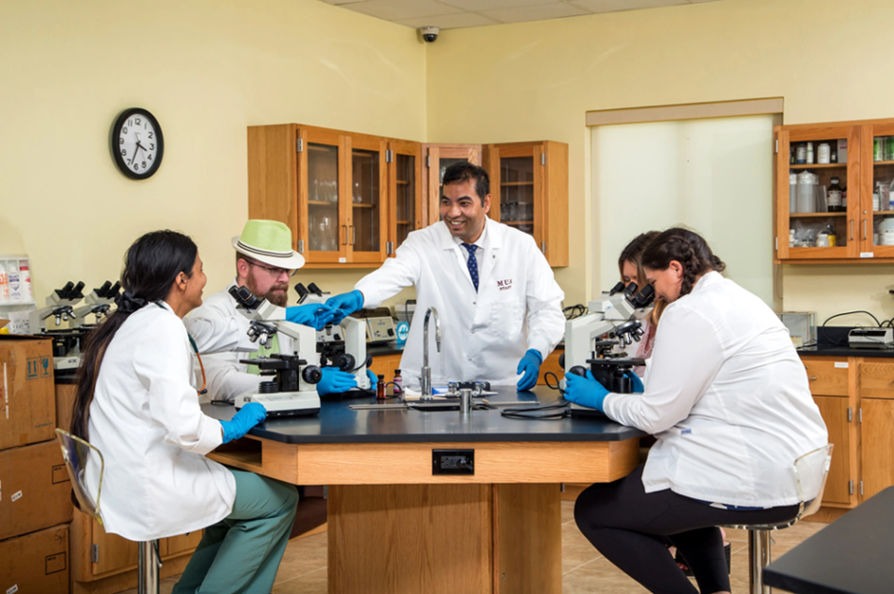
Microbiology (with lab)
BMS 205
Credits: 4
In the course Microbiology, a general introduction to the microbial world with information on microbial physiology, growth and its control, nutrition, interactions within various ecosystems, endogenous human organisms, human disease, biotechnology, and industrial aspects will be presented. Virtual laboratory exercises are a component of this course.
Organic Chemistry (with lab)
BMS 105
Credits: 4
This course offers students the opportunity to learn about the nature of carbon in organic compounds. It presents general principles of organic chemistry related to structure, stereochemistry, nomenclature, synthesis, uses and reactions of alcohols, ethers, and aliphatic hydrocarbons (alkanes, alkynes, alkenes, cycloalkanes).
Medical Terminology*
BMS 103
Credits: 2
Medical Terminology prepares pre-medical students for the complex language of medicine. Students will become familiar with the vocabulary for accurately describing the human body and associated components, conditions and processes in a scientific manner. This course will also help students understand unfamiliar medical terms and appreciate their clinical applications.
Semester 2
16 credits
Biochemistry (with lab)
BMS 206
Credits: 4
This is an advanced course in the structure and reactivity of functional groups (aromatic compounds, carbonyl compounds, carbohydrates, organometallic compounds, carboxylic acids and their derivatives, amines, and amino acids). This course covers the essential prerequisite material needed for Biochemistry.
Communication for Health Professionals
BMS 303
Credits: 3
The course Communication for Health Professionals develops students’ skills in locating, selecting, evaluating and using research to answer questions, which are personally and professionally relevant. The course will help students to develop skills in reading, paraphrasing, summarizing, writing clearly and effectively, and in appropriately documenting sources. Students will learn to evaluate research methods, be introduced to basic concepts in evidence-based medicine, and will analyze structure and writing style in research articles.
Introduction to Histology
BMS 111
Credits: 4
This course introduces students to the microscopic structure of cells, tissues and organs as the foundation for understanding human biology and disease. Emphasis is placed on developing visual recognition skills and correlating microscopic structure with cellular and tissue function. Students will learn to identify major tissue types, interpret histological images, and describe structural features in clear biomedical language.
Cell and Molecular Biology
BMS 302
Credits: 5
In this course, students will gain an understanding of cellular functions. Topics include: macromolecular function and regulation, mechanisms of gene expression and inheritance, cell structure and function, and diagnostic biotechnology.
Semester 3
15 credits
Introduction to Nutrition or Health and Disease
BMS 106/206
Credits: 3
The course Introduction to Nutrition presents basic nutrition information that will help students understand the relationship between diet and the prevention/control of diseases.
The course Health and Disease introduces students to basic concepts related to nutrition, microbiology, (co-) evolution, heritable disease and substance abuse. It provides students the opportunity to understand biology, health and disease in the context of heredity and infectious disease.
Medical Physiology
BMS 301
Credits: 4
In the course Medical Physiology, students learn the normal functions and regulation of cells, organs and organ systems, and physiological integration of the systems to maintain homeostasis – with emphasis on clinically relevant concepts. Lectures cover the neural and humoral homeostatic mechanisms and understanding of the physiology of muscular, cardiovascular, respiratory, endocrine, reproductive, gastrointestinal and renal systems. In addition, the pathophysiology of selected disease states is explored.
Clinical Anatomy
BMS 300
Credits: 4
This is a lecture and laboratory course where students will acquire a basic knowledge of both the gross structure and functional anatomy of organs and systems. Concurrent with lecture and small group work, students participate in laboratory sessions and study a variety of imaging techniques (including X-rays, CT and MRI scans). Emphasis is on the identification of normal gross structures, with lectures and demonstrations used to illustrate clinically relevant normal and abnormal findings.
Genetics
BMS 306
Credits: 4
In the course Genetics, the principles of classical, molecular and population genetics will be discussed. The course will provide a historical background of heredity and a review of advances in gene structure and function. Students are expected to develop problem-solving skills over the course of their studies. The application of genetic principles to medicine will be emphasized throughout the course.
*The Medical Terminology course is offered exclusively online. This course also offers the option to test out of the class. All other courses may be attended either in-person on the Medical University of the Americas campus, or online.
Questions?
Please contact us at info@mua.edu for more information.