AI in Medicine: Benefits, Risks, and Ethical Concerns
Explore how artificial intelligence is shaping modern medicine, from improving patient care and advancing medical research to transforming medical education
AI in medicine is moving from research settings into clinical practice. Artificial intelligence in medicine already appears across medical imaging, diagnosis, drug discovery, and personalized care. Many forms of AI technology in healthcare aim to ease clinicians’ workloads and improve care, but they also raise questions about accuracy, bias, transparency, and accountability.
This guide offers a balanced look at AI in healthcare: what it does, where it helps, and where it can go wrong. The field changes quickly, so treat every claim here as a starting point for your own reading.
What Is AI in Medicine?
AI in medicine refers to computer systems that learn from data to perform tasks that usually require human judgment, such as reading scans or summarizing records. Physicians make the final decisions.
What Technologies Power AI in Healthcare?
Three main types of artificial intelligence in healthcare appear most often, as IBM’s overview of AI in medicine describes.
| Technology | What It Does | Example |
|---|---|---|
| Machine learning | Finds patterns in data | Flagging suspicious areas on scans |
| Natural language processing | Reads and organizes text | Summarizing clinical notes |
| Generative AI | Produces text or images | Drafting documentation for physician review |
The applications of artificial intelligence in healthcare below are most relevant to future physicians.
How Is Artificial Intelligence Used in Medicine?
A common use of AI in medicine is through software that finds patterns in large datasets before a clinician reviews the results. The clinician then decides what to do next.
AI in Medical Diagnosis and Imaging
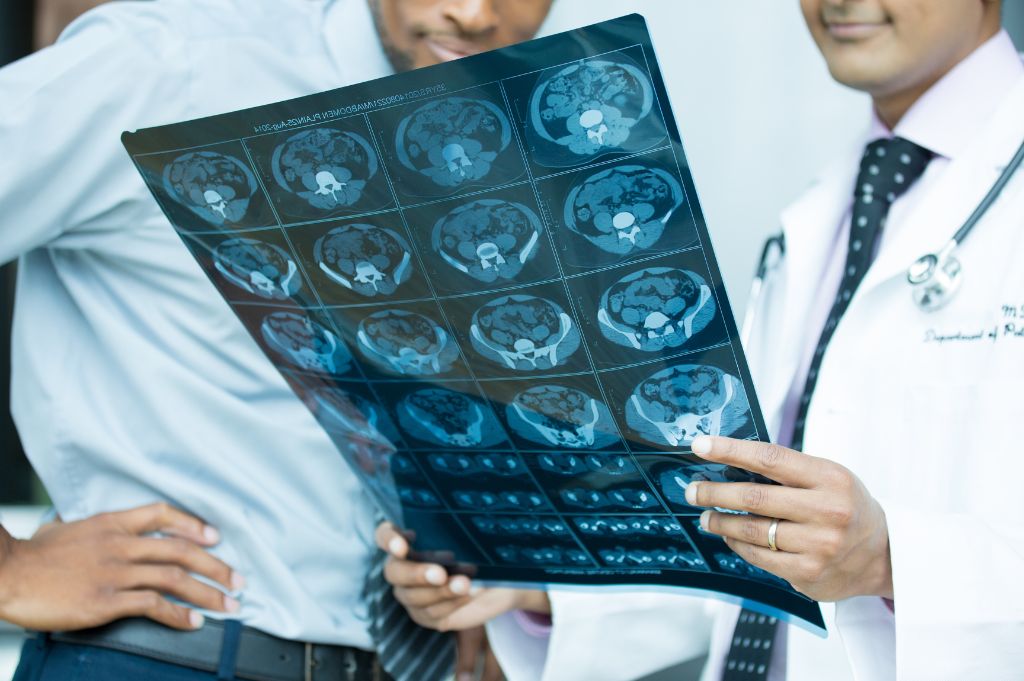
On X-rays, CT scans, and pathology slides, algorithms are being trained to mark areas that look unusual so a radiologist or pathologist can examine them first. That is how AI in clinical medicine is most often framed: the software points, and the clinician decides what the finding means.
AI in Drug Discovery and Development
Before a single experiment begins, researchers can run enormous compound libraries through AI models that predict how molecules are likely to behave, narrowing thousands of candidates to a shortlist worth testing. The shortlist is only a starting point, though. Whether a compound advance is settled in the laboratory and in clinical trials.
AI in Personalized Medicine
AI in healthcare and medicine can analyze genetic, lab, and lifestyle data to help tailor treatment options to individual patients.
AI in Clinical Decision Support
These AI healthcare use cases include surfacing relevant guidelines and estimating patient risk.
AI in Robotic and Surgical Care
Some AI machines in healthcare support surgical planning, and in current clinical use, surgeons remain in control of the procedure.
AI in Patient Monitoring and Predictive Analytics
AI in hospitals can take the form of models that analyze vital signs and records to flag patients who may be at risk of deterioration. Performance in real hospitals can differ from developer testing, which is why validation matters.
AI in Medical Research and Clinical Trials
Researchers use AI to sort literature, analyze large datasets, and match patients to trials. This is one answer to how has AI helped the medical field: it may speed up data handling.
AI in Administrative and Healthcare Workflows
AI in healthcare services includes tools for documentation, scheduling, and coding that may reduce paperwork. AI is also starting to appear in medical education.
In short: many current applications focus on pattern recognition and paperwork.


What Are the Benefits of AI in Medicine?
The benefits of AI in medicine are promising, but they depend on data quality, careful implementation, and human oversight.
Can AI Improve Diagnostic Accuracy?
Researchers are studying whether AI in clinical medicine can support clinicians in image review, and results vary by dataset and setting. These advantages of artificial intelligence in medicine depend on evidence.
How Can AI Support Earlier Disease Detection?
Pattern recognition may help flag subtle signs sooner, such as on screening images, so a clinician can follow up promptly. This is one of the benefits of artificial intelligence in medicine that researchers are studying closely.
Can AI Improve Personalized Patient Care?
It may help. AI for doctors can combine patient data to suggest options tailored to an individual. The physician then weighs those options against the patient’s goals.
How Does AI Improve Healthcare Efficiency?
The impact of AI in healthcare on efficiency includes faster triage and image prioritization, which can free up clinician time.
Can AI Reduce Administrative Work for Physicians?
Documentation is a familiar pain point for physicians, and note-drafting tools are one of the first places AI has found a practical footing. A draft that arrives ready for review saves typing time, but nothing enters the record until the physician has read it and corrected any errors.
How Can AI Support Medical Research?
A research team facing thousands of new papers and sprawling datasets has a lot to sort through before the real work starts. AI tools take on some of that sorting, from screening literature to analyzing data, so teams can reach the testing stage sooner.
Can AI Improve Access to Healthcare?
In some settings, possibly. Among the opportunities and challenges of artificial intelligence in healthcare is extending screening or triage to areas with few specialists. This requires reliable infrastructure and validation.
What Are the Risks and Challenges of AI in Medicine?
AI in medicine carries risks that can affect clinical decisions and patient care. Clinical validation, responsible implementation, and human oversight reduce them.
Can AI Make Mistakes in Medical Decision-Making?
Yes. Models can misclassify findings, especially in patients who differ from the data the model learned from. Clinicians should check outputs against the whole clinical picture.
What Is AI Bias in Healthcare?
AI bias occurs when training data underrepresents or misrepresents certain groups, which can lead to less accurate results for some patients. AI in healthcare needs diverse, audited data.
How Can AI Affect Patient Privacy?
Many tools rely on sensitive health data. Weak security or unclear data use can expose patients, so physicians must follow institutional policy and privacy law when using AI in medicine.
Why Is Transparency Important in Medical AI?
Some models are harder to interpret. When clinicians cannot see why a tool made a recommendation, it is harder to check, challenge, or explain to a patient.
What Is the Risk of Overreliance on AI?
Automation bias is the tendency to accept a tool’s suggestion without question. AI for medical professionals works best when users continue to apply independent judgment.
Can AI Produce Inaccurate or Misleading Information?
Yes. Generative tools can produce confident but incorrect text, so artificial intelligence medical outputs need verification against trusted sources. This is known as AI hallucination (IBM, 2023).
What Challenges Exist When Implementing AI in Healthcare?
Hospitals face integration with records systems, staff training, cost, regulation, and ongoing monitoring of AI technology in healthcare.
What Are the Ethical Concerns of AI in Medicine?
In AI and medicine, the main ethical concerns are privacy, informed decision-making, transparency, accountability, fairness, bias, and patient autonomy. Patients should know when AI influences their care and be able to ask questions.
Healthcare professionals should stay involved in important clinical decisions. Responsible AI in healthcare includes validation, auditing, clear accountability, and human oversight, all of which help protect patients.
Will AI Replace Doctors?
Current evidence points toward AI working alongside physicians, though no one can predict the future with certainty. When people ask, “Will AI take over medicine?” the answer starts with what medicine requires. AI can automate or support certain tasks, but practice also needs clinical reasoning, communication, empathy, ethical judgment, and responsibility.
So how will AI affect doctors? Most likely by becoming a clinical tool they use alongside their expertise. Students should build strong medical knowledge and the ability to critically evaluate and challenge AI-generated output.
How Can Medical Students Prepare for AI in Medicine?
A working knowledge of AI for doctors is enough: how the tools work at a basic level, where their limits are, how to evaluate AI-generated information critically, and what ethical responsibilities come with using them.
How Could AI Change Patient Care?
It may speed up documentation and risk flagging, giving physicians more time for patient conversations. Pay attention to how AI is being used in healthcare settings during your training.
What Emerging AI Applications Could Shape Medicine?
Ambient documentation, predictive analytics, and AI-assisted diagnostics are areas to watch. Follow peer-reviewed studies on AI applications in healthcare to see what the evidence supports.
How Might AI Influence Medical Research and Education?
AI may change how students study, from practice questions to tutoring tools. Always verify the output. Our guides to free study apps for medical students and free resources for medical students are a helpful starting point.
What Role Will Physicians Play in an AI-Enabled Healthcare System?
Physicians will likely remain responsible for diagnosis, treatment decisions, patient communication, and oversight of AI in medicine.
At Medical University of the Americas (MUA), the 4-Year MD Program includes five semesters of classroom and lab-based learning on our Nevis campus, followed by five semesters of clinical rotations at affiliated teaching hospitals in the U.S. and Canada.
What Does the Future of AI in Medicine Look Like?
The future of AI in healthcare and medicine holds emerging possibilities that are still being tested. These include personalized medicine, predictive analytics, AI-assisted diagnostics, medical research, clinical documentation, and education. UNSW’s look at AI in healthcare offers one perspective on careers in this area.
Adoption will depend on evidence, safety, regulation, ethical implementation, and physician oversight. Artificial intelligence in medicine is likely to earn lasting trust only by showing it helps patients.
Conclusion
The benefits of AI in medicine rely on data quality and oversight, and the risks include errors, bias, privacy gaps, and overreliance. Ethical use depends on transparency, accountability, and physician oversight. For prospective students, that means building strong medical foundations, learning to question AI-generated information, and following how AI in medicine develops.
Interested in studying medicine at MUA? Explore the 4-Year MD Program and review the admission requirements. MUA offers three start dates every year: January, May, and September.
FAQs About AI in Medicine
It can be, but only when the tools are validated, monitored, and used with a physician’s oversight. Risks include errors, bias, and privacy breaches. AI in medicine should support professional judgment, with a physician overseeing its use.
Current evidence suggests artificial intelligence in medicine will work alongside physicians. It can automate some tasks, while empathy, ethical judgment, and accountability remain human responsibilities.
Disadvantages include biased data, errors, and privacy concerns. Managing these risks in AI in healthcare requires clinical validation and human oversight.
Yes. Students benefit from knowing how AI tools work and where they fail. This builds the skill of evaluating AI output, which is becoming a more common part of practice for AI for medical professionals.
Doctors interpret AI output, make final decisions, communicate with patients, and remain accountable. AI for doctors is a tool to support the decision-making process.
Doctors can use artificial intelligence responsibly by choosing validated tools, verifying outputs, protecting patient data, being open with patients about AI use, and following institutional policy. Using AI in medicine responsibly means keeping physician judgment central to every decision.
Useful Links
MUA is committed to supporting prospective students throughout the admissions process. Please click the following links for detailed information about each topic: